
AI Foundation
Edit on GitHubOverview
Spryker AI Foundation is the core layer that connects your Spryker Commerce OS to leading AI providers in an enterprise- and EU-friendly way.
You get a standardized, provider-agnostic way to build AI-powered commerce experiences, and you can choose the right AI provider and model for each use case, using:
- Global cloud AI platforms such as Azure OpenAI, AWS Bedrock, and Google Vertex AI / Gemini
- Frontier model providers such as OpenAI and Anthropic Claude
- European sovereign AI providers such as Mistral AI
- Any other provider, configurable per feature independently
The goal is simple: make AI a first-class capability of your commerce platform, not a collection of isolated experiments.
Business problems it solves
Traditional AI projects in commerce often run into the same obstacles:
- Many separate integrations with different AI providers and libraries
- No common standards for security, logging, or error handling
- High dependency on a specific provider or model
- Lack of options for EU data residency or sovereignty-sensitive use cases
- Slow rollout of AI features across multiple markets and storefronts
Spryker AI Foundation addresses these challenges by introducing one common layer for AI in your commerce stack.
Key value for your business
-
Faster delivery
Developers get ready-to-use building blocks and connectors, so AI features reach your customers in weeks instead of months. -
Provider freedom
Your teams can connect to Azure OpenAI, AWS Bedrock, Google Vertex AI, OpenAI, Anthropic Claude, Mistral AI, or other providers through a single abstraction and keep the option to switch providers or combine them later. -
Consistent developer experience
A unified approach to prompts, requests, and responses across providers simplifies onboarding, code reviews, and long-term ownership. -
Lower maintenance effort
Handle changes to models, prompts, or providers in a central layer to reduce duplicate work across projects and rollouts. -
Best fit provider per use case
Use different providers and models for different needs. For example, use a model optimized for complex reasoning in a shopping assistant and another model optimized for cost-efficient content generation, without changing your commerce applications.
Who benefits and how
For business leaders
-
Reduced risk
Avoid lock-in to a single AI provider and keep strategic options open as the AI market evolves. -
EU and compliance readiness
Combine global platforms with European sovereign AI providers such as Mistral AI to address data residency, GDPR, and EU AI Act requirements. -
Faster innovation cycles
New AI-driven use cases can be piloted and rolled out more quickly on top of a common foundation. -
Better use of internal teams
Developers focus on customer value and differentiation, not on building and maintaining low-level AI integrations.
For product and commerce teams
-
Reusable patterns
Once a pattern for AI-powered search, content, or assistance is proven, it can be reused across channels, brands, and countries. -
More experiments, lower cost
Trying a new provider or model for a specific use case becomes a configuration and testing activity, not a project. -
Closer collaboration with tech
A common foundation and shared vocabulary make it easier to plan AI initiatives together with engineering.
For developers and architects
-
Standardized APIs
Use one consistent API to call AI providers such as Azure OpenAI, AWS Bedrock, Google Vertex AI, OpenAI, Anthropic Claude, and Mistral AI instead of learning each provider SDK and behavior. -
Simpler architecture
AI related concerns such as configuration, error handling and response normalization sit in one layer rather than spread across services. -
Future readiness
New providers or models can be added behind the same interface, which keeps the overall architecture stable.
Typical use cases built on Spryker AI Foundation
AI Foundation is not a single feature. It is the base for many AI-enabled scenarios, for example:
-
Generative AI (GenAI) shopping assistants
Conversational assistants that help B2B buyers find the right product, check compatibility, and understand technical details by using one or more providers in the background. For example, you can use OpenAI or Anthropic for reasoning and combine them with an EU provider for sensitive data. -
AI-powered product content
Translation, enrichment, and improvement of product descriptions and attributes at scale, aligned with your brand and channel guidelines. This can use specialized translation capabilities together with general-purpose models. -
Smart search and discovery
AI-enhanced search and navigation that can better understand intent, synonyms, and domain-specific language, running on your preferred cloud AI platform. -
AI-assisted back office workflows
Context-aware suggestions for catalog management, pricing, or data imports that make business users more productive, while keeping data in EU-based providers where required.
Each of these use cases can evolve independently while still relying on the same AI Foundation underneath.
Audit Logs and cost estimator
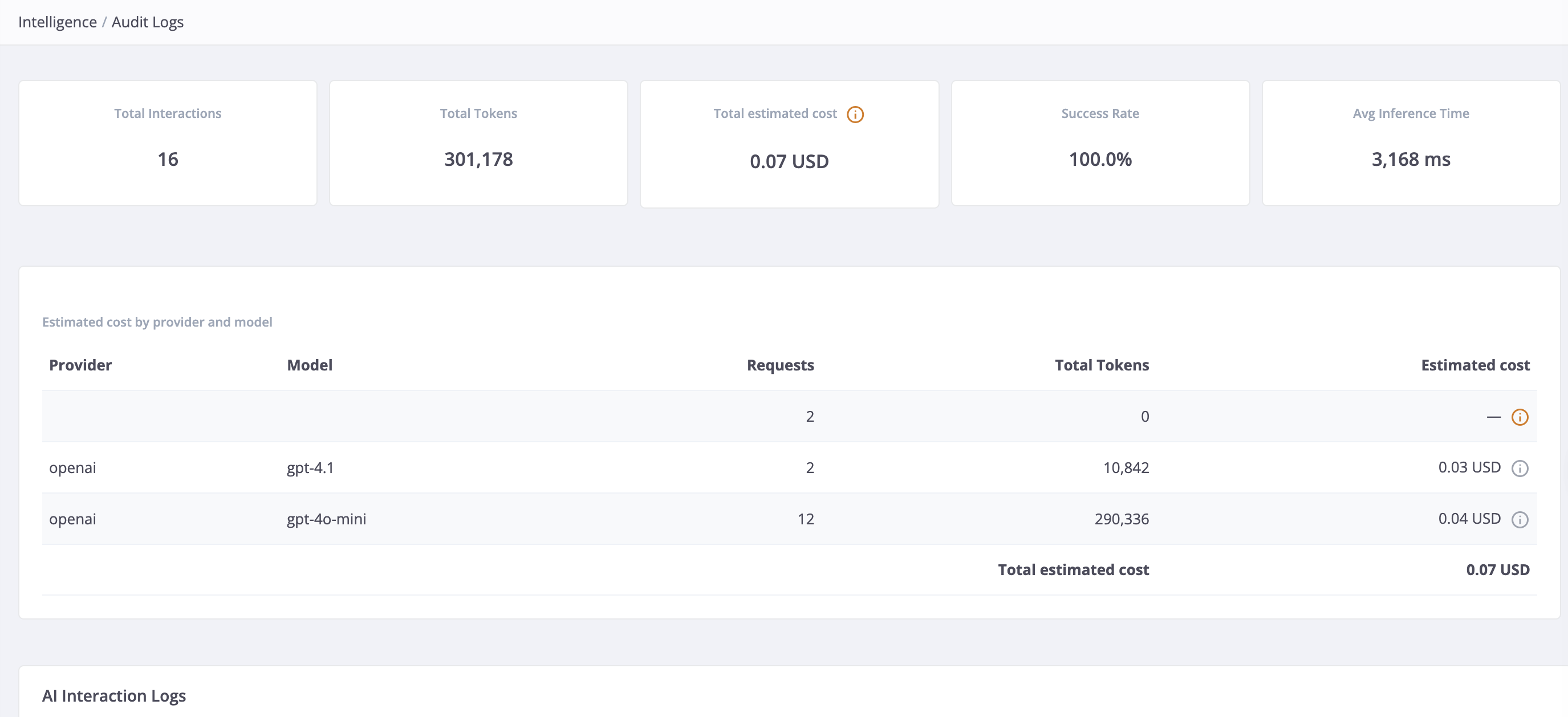
AI Foundation includes built-in audit logging for every AI interaction. All prompts, responses, token usage, inference times, and statuses are captured automatically and are available in the Back Office at Intelligence > Audit Logs.
The Audit Logs page provides:
- Summary statistics: Total requests, tokens consumed, success rate, average inference time, and total estimated cost.
- Cost estimator: Per-provider and per-model cost breakdown based on token prices you configure. Prices are entered in the Back Office per model and applied at display time, so changing a price immediately revalues all historical interactions.
- Filterable log table: Filter by configuration name, status, conversation reference, and date range.
- Detail drawer: View the full prompt, response, token breakdown, metadata, and error details for any interaction.
For setup instructions, see AI Foundation Audit Logs.
How Spryker AI Foundation fits into your architecture
At a high level, Spryker AI Foundation sits inside Spryker Commerce OS and connects your channels (Storefronts, GLUE API, Back Office) with the AI providers you choose for each use case:
[ Storefronts ]   [ GLUE API ]   [ Back Office ]
          \          |             /
           \         |            /
            v        v           v
           [ Spryker Commerce OS ]
          [ Spryker AI Foundation ]
               - Common API
               - Provider abstraction
               - Configuration
               - Routing per use case
                     |
                     v
              [ AI providers ]
                - Azure OpenAI
                - AWS Bedrock
                - Google Vertex AI / Gemini
                - OpenAI
                - Anthropic Claude
                - Mistral AI
                - Others, based on project needs
Thank you!
For submitting the form